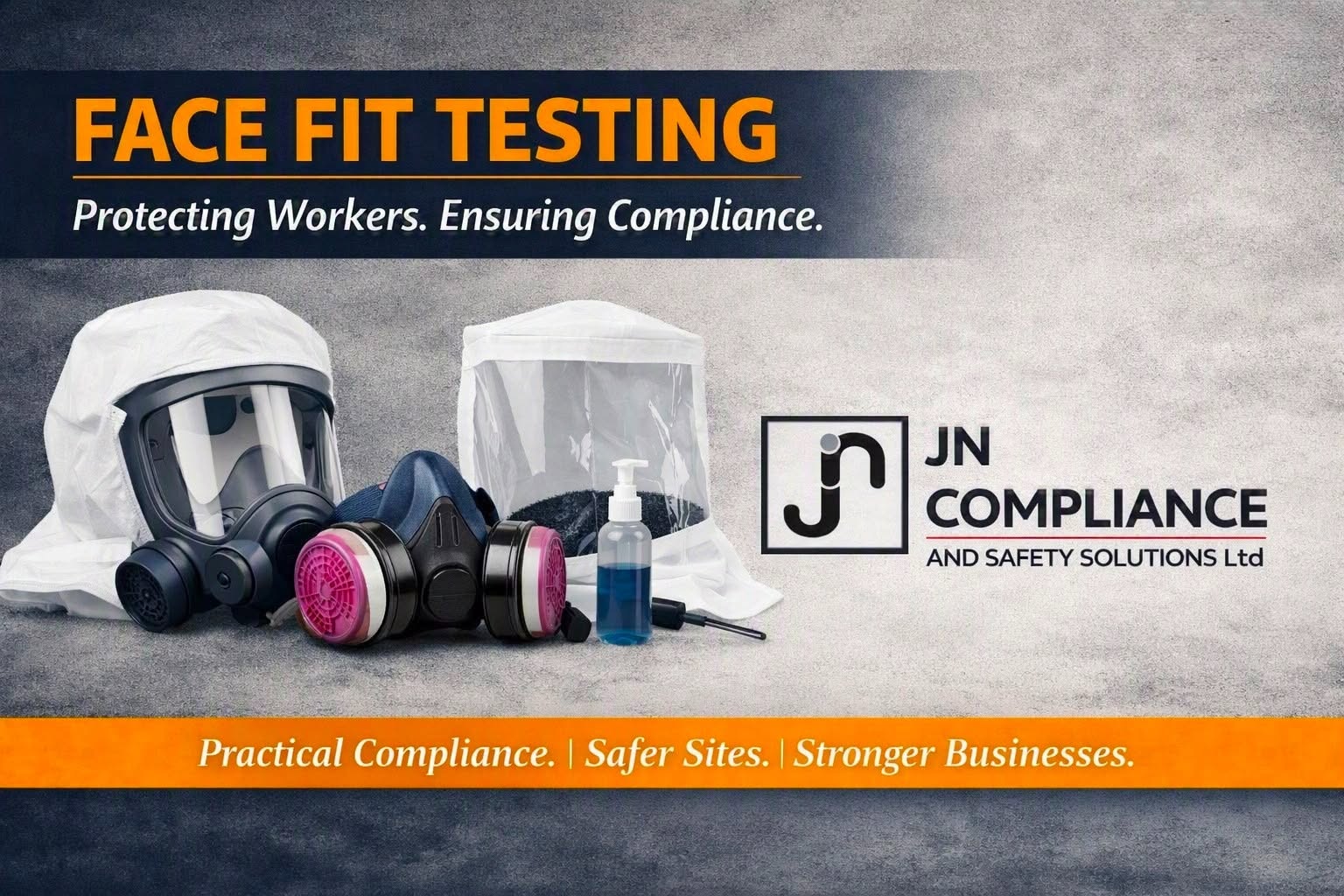
Correctly fitted Respiratory Protective Equipment (RPE) is essential for protecting workers from dust, fumes, chemicals and airborne hazards — and it is a key requirement under HSE and COSHH regulations. Our qualitative face fit testing service checks that tight-fitting masks seal properly to the wearer's face, giving you confidence that your workforce is genuinely protected.
What's included
- Qualitative face fit testing for tight-fitting RPE
- Tests carried out by David Dolan-Davis — trained Qualitative Face Fit Tester (Face Fit Train the Tester, Essential Site Skills, valid to Aug 2029)
- Professional guidance on mask selection, correct use and maintenance
- Fit test certificates issued for employer records
- Audit-ready documentation and test logs
- On-site testing for contractors, maintenance teams and operatives
How the testing works
Each test follows the HSE-recommended qualitative procedure and takes around 10–15 minutes per person.
- 1
Pre-test check
We confirm the make, model and size of mask each person normally wears, check the mask is clean and undamaged, and go through the things that break a seal — beard or stubble, facial piercings, recent dental work or a change in weight. Everyone is asked not to eat, drink, smoke or chew gum for around 20 minutes beforehand.
- 2
Putting the mask on
The wearer fits the mask themselves and adjusts it the way they would on a normal working day: headstraps tensioned, nose clip shaped, no twists or kinks in the straps. We check it sits correctly before any testing starts — a mask worn badly will fail however well it is made.
- 3
Taste threshold
With eyes closed and breathing normally, a harmless test agent is sprayed into the inlet of the mask and we count how many sprays it takes before the wearer can taste it. The more sprays needed, the better the seal. Tasting it almost immediately means air is leaking in around the face.
- 4
Sensitivity check
If the wearer cannot taste the agent at all, we test sensitivity first without the mask on. Around one person in ten cannot taste the standard agent, so we switch to a different one and repeat the test rather than issue a result we cannot rely on.
- 5
Adjust, swap and re-test
If the agent is tasted, the seal has failed. We adjust the fit and test again — and if it still fails, we move to another size or a different make and model until one passes. Different faces suit different masks, which is exactly why testing is worth doing.
- 6
Record and certificate
The make, model, size and result are logged for every person tested and a fit test certificate is issued for your records. From that point on, that same make, model and size must always be worn — changing it means testing again.
Who needs testing
- Full-face masks and powered air-purifying respirators (PAPR) — these need quantitative fit testing
- Oxygen-deficient or confined spaces and other immediately dangerous atmospheres, where respiratory protective equipment alone is not enough
- Anyone with facial hair touching the sealing surface — a mask cannot seal through a beard or stubble, so it has to be shaved first
How to prepare
A little preparation on your side makes the day run smoothly and keeps the results valid.
- A list of everyone who wears a mask, with the full names you want shown on the certificates
- The actual masks they wear — same make, model and size. If more than one size is in use, bring each one, because we test every combination a person might wear
- Your COSHH assessment or risk assessment for the tasks, so the mask and filter class being tested match the hazard
- Shaved before you arrive, with no beard, stubble or chin growth where the mask seals
- No eating, drinking, smoking or chewing gum for about 20 minutes before your test, and a clean face without heavy cream
- A quiet, draught-free indoor space with a chair and a small table, away from eating areas and extract ducts
- Roughly 10–15 minutes per person, scheduled before a shift or in a quiet window so nobody is rushed
- Let us know in advance about pregnancy, allergies, asthma, heart or respiratory conditions, a cold or blocked nose, or if you suspect you cannot taste the test agent
A workforce protected by properly fitted RPE and a clear record of compliance you can show to clients, HSE and insurers.